
Dallas built this roster through trades, not through the lottery, and now owes or has swapped nearly every first-round pick through 2030. Cooper Flagg, the exception, is the argument that the bet already paid off.

The Trade Built Core
P.J. Washington arrived from Charlotte, Daniel Gafford from Washington, Naji Marshall in free agency, and Max Christie in the trade that sent Luka Doncic to the Lakers and brought back Anthony Davis. None of them came through Dallas' own lottery ticket. That approach costs $197.9 million across 18 contracts, over the cap and below the $200.4 million luxury-tax line, led by Kyrie Irving's $39.5 million, Washington's $19.8 million, Klay Thompson's $17.5 million, Gafford's $17.3 million and Santi Aldama's $17.0 million.
The Draft Capital Bill
Every pick left on Dallas' board through 2030 carries a string: the 2027 first is protected to Charlotte, the 2027 second and the 2028, 2029 and 2030 firsts are swaps, and the 2028 second is owed to the Clippers with the 2029 and 2030 seconds owed to Brooklyn. Those obligations trace back to the same trades that built the roster — the cost of adding Washington, Gafford and Christie without touching Dallas' own lottery slot. If the trade-built core needs a reset, Dallas has almost nothing of its own left to make it with.
Why Flagg Answers It
That is the bet Dallas made, and Cooper Flagg is the return on it. The No. 1 pick in 2025 after Dallas won a lottery with less than a 2 percent shot at the top slot, Flagg averaged 21.0 points, 6.7 rebounds and 4.5 assists at 19 last season. His 29.5 percent mark from three is the counterweight, a superstar snapshot with real flaws still to fix. Last season's 26-56 finish, 27th in offense and 19th in defense, is the price paid so far for building around trades instead of picks. The answer, on that evidence, is yes: one draft hit like Flagg is worth more than a decade of others' picks, as long as he keeps climbing.
What draft picks does Dallas still control outright through 2030?
None of its own firsts are unconditional: the 2027 first is protected to Charlotte, and the 2028, 2029 and 2030 firsts are all swaps, with seconds owed to the Clippers and Brooklyn.
Is Cooper Flagg's rookie season enough to justify the trades?
On last season's numbers, yes — 21.0 points, 6.7 rebounds and 4.5 assists at 19 — though a 29.5 percent three-point mark shows the game still has room to grow.
More from The Big D Breakdown
all Mavericks news → From the archives · Sat, Sep 26From the Archives: What 15-67 and 21 Seasons Say About This Roster
 Morning · Sat, Sep 26Powell Returns, Payroll Holds Steady Below the Tax Line
 Around the beat · Fri, Sep 25Around the Beat: Powell Signs, Irving Trade Talk, Flagg's Stock Climbs
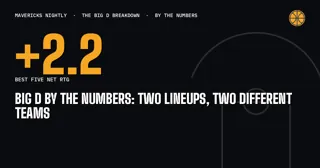 By the numbers · Fri, Sep 25Big D By The Numbers: Two Lineups, Two Different Teams
 Morning · Fri, Sep 25Gafford's Center Job Gets More Interesting Overnight
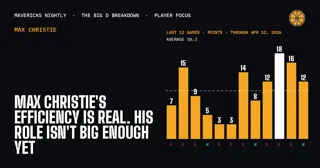 Player focus · Thu, Sep 24Max Christie's Efficiency Is Real. His Role Isn't Big Enough Yet